A quick glance through Facebook photos within your network and food pictures are bound to show up on almost every profile. Sharing of food images is not new, but when you overlay a social layer coupled with a recommendation engine… you get Foodspotting!!
Foodspotting is a location-based crowd-sourced food recommendation app that sorts the best dishes in your vicinity based on actual photos shared by visitors to those locations. All that one has to do is snap a photo of a share-worthy dish at a restaurant with the application, tag and share it on Foodspotting or via Twitter, Facebook, Foursquare, etc. So, if you’re famished and would like to grab a bite that has earned its stripes, merits consideration, and is also nearby, simply open the app and browse actual photos. Food spotting is different from other restaurant apps in that it is probably one of the only mobile apps out there that’s focussed on food discovery (not restaurants) and recommendations unlike Yelp, Urbanspoon, and Zagat .
Being able to find directions to a restaurant and read its reviews is helpful, but it’s not fun when you have to sift through them all to know what’s most recommended. The truth is that ‘people really eat with their eyes’ and that’s what makes browsing the Foodspotting interface a pleasurable experience. On opening the app, picture after picture stokes up your appetite while reminding you that some mouth-watering Veal Saltimbocca is just minutes away from you. If you so desire, you can switch to map view and spot all the dishes tagged around you or you can search for a specific item you might have in mind. If a recommendation that matches your search is tagged it should show up (I say ‘should’ because I tried searching for ‘Beefsteaks’ and the closest place featured was somewhere in LA… a little too far to make it worth the effort…right?).
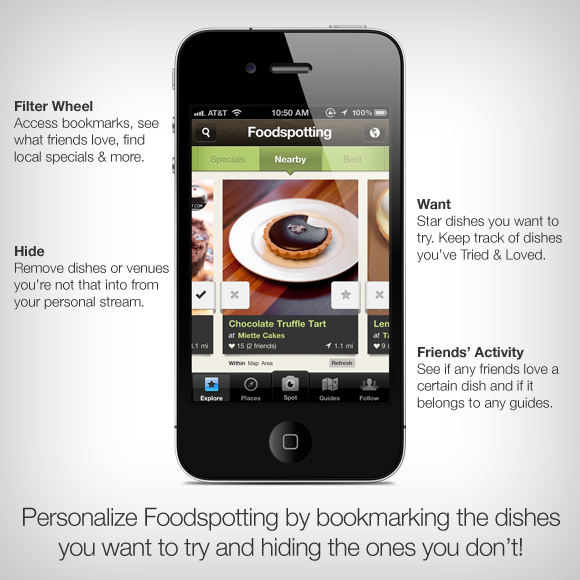
The UI is simple and intuitive. It has what the company terms a “Pandora-like interface” which lets browsers tag dishes as ‘want it’, ‘loved it’, and ‘tried it’. Or, if you choose to not see a particular dish in your listing you can even ‘hide it’. Categories listed as ‘Specials’, ‘Best’, ‘Nearby’, and ‘Latest’ feature the tagged dishes to select from and it seems like the company consciously chose to avoid cuisine based categorization which can sometimes make the navigation feel clunky.
So far the app has over 1 million downloads and is going strong. I’d give it a thumbs up and am choosing to ignore the ‘Beefsteaks’ incident for now.

 Deric's blog