Mobile search – Promising results

Mobile SEO search

Following up on my previous post on Google’s ‘Mobile Playbook‘, I’d like to share some interesting mobile search stats regarding mobile-search behavior taken from an xAd report. The Q4 ’11 report showcases mobile-local usage trends and consumer behavior between locally targeted search and display across their network. Besides reporting a 60% increase in mobile-local search traffic alone (not counting display traffic) between Q3 to Q4 ’11– much of which can be attributed to the shopping season – some other standout highlights were:

Driving call to action: 1.3 million calls were placed to local businesses and 73000 drives or walk-ins to local storefronts in Q4 (*Drives and walk-ins are a measurement of the number of times users accessed maps and driving directions as part of their ad interaction)

High CTR and secondary actions rate: Click-through rate (CTR) for targeted local search is a staggering 7% as against only 0.6 % for targeted mobile display with a “secondary action” rate of 37% and 5% respectively. Secondary actions are additional post-click activities (click-to-call, search on a map, show prices, driving directions, etc) and this is your conversion pipe which makes mobile website optimization all the more critical since we know that Google is indexing local mobile sites differently.

Click-to-call v/s finding directions: Following the initial click, 52% of search-ad users make calls to local businesses as compared to 30% for display. The leading secondary action for display is accessing maps and/or directions which stood at 50%, versus 42% for search ads. A key observation as revealed by the data is that search-ad users aren’t really seeking info /reviews (< 5% secondary action) as compared to 20% for display-ad users. This reinforces the fact the search-ad users are seeking specificity. Another key factor in mobile search is the reduced time gap between intent to action as queries have a high degree of localization as compared to desktop searches

Time of Day: Locally targeted display steadily ascends through the day and peaks after work hours at 6:00 pm until after 10:00 pm with the most activity on Thursdays. Local mobile search tends to taper off after lunch; peaks on Fridays and tapers off by Sunday.

 Access platforms: While mobile browser access is still primary and larger than in-app searches, iOS and Android users prefer in-app access and as conversions from feature phones to smart devices continue to happen so could this trend.

The above suggests that when optimizing for mobile, a cross-platform approach as well as leveraging usage spikes through the day ensures that all audiences are reached and increases the opportunity for ads to be seen and acted upon. Besides, best practices in mobile SEO strategies when optimizing for platform and device should be given attention; after all mobile search volumes and CTR’s growing and there is an advantage in being early to the party.

Deal or no deal?

Find deals on restaurants around you

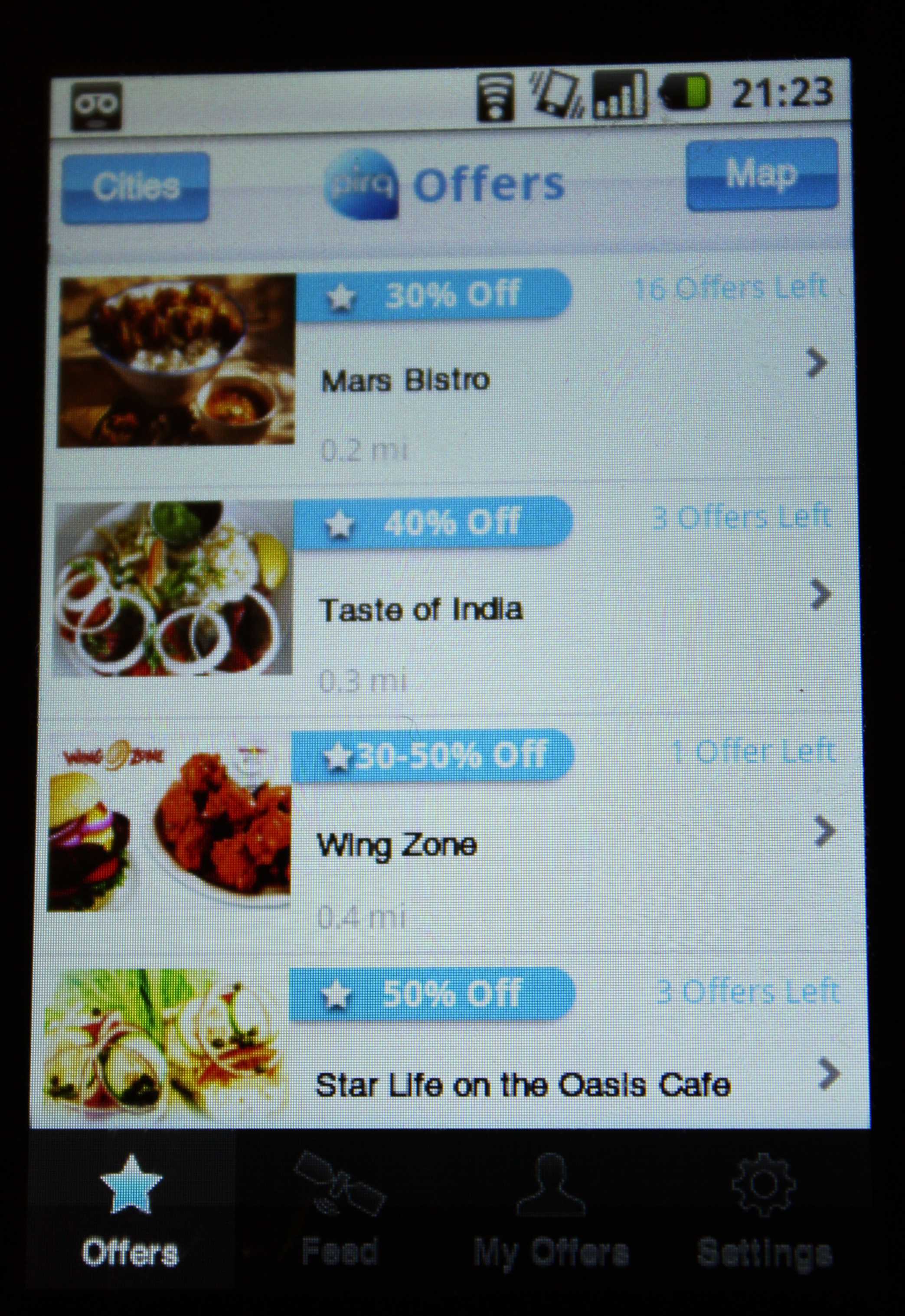
When in doubt about what to eat, a sandwich pretty much does the job. It’s quick, satisfying and filling. So while soaking in a bright sunny Sunday, I stepped into ‘Which wich’ on ‘The Ave’ to grab a sandwich. Having made my selection and approaching the payment desk I noticed mini-poster which had a rather large Microsoft tag on it promoting a special offer. It was a partnership with Pirq- a deal and discount mobile application

I whipped out my phone to scan the tag expecting to retrieve a simple mobile discount coupon which I could victoriously waive in front of the cashier. Instead, the tag opened the Pirq web page and from here on began the tap dance. Inching and pinching my way on the screen I tapped the ‘Install for Android’ button. At this point I realised that I was holding up a queue behind me and without intention had also set in motion a small chain of tag scanners. As expected, a couple of them didn’t have Microsoft tag scanner installed on their phones.

Coming back to the tap dance, the installation through the webpage failed for some weird reason and so I attempted downloading it from the Android app store. Post download I had to sign in either using Facebook or with my email id and zip code. I chose the latter hoping that I could finally stake claim to some gastronomically delightful deals. But whoever said success doesn’t come easy was right; at this stage a message popped up informing me that a confirmation link has been sent to my email id….I’m tearing my hair right now….pfff. The latent sense of achievement was now beginning to border on embarrassment and so I paid full price for the sandwich and left the place.

Determined to see this through, on reaching home I completed the email confirmation step and voila!!! …..another hoop…… I now had to choose a password to use the service.

This is a classic case of a sign in system that’s frustrating and broken. A complex process that forced me to self-forfeit a deal and a user experience that only ensured that a sandwich didn’t taste as good as it could have.

Since Pirq had a promotion running at the outlet I would’ve made one simple change to ensure that drop offs from new customers don’t occur due to the experience above. If a user didn’t already have the the Pirq app installed on his phone, on scanning the tag a mobile coupon to redeem the offer instantaneously should have been sent along with a simple app download button and a message stating “Download the Pirq app to avail of more deals like this”. Having tasted success, the user would be positively predisposed to go through the sign in mechanism. Even here, all data input ought to be captured on one form avoiding the tap dance described above.

The app itself is pretty cool. It listed offers from nearly 15 restaurants within a couple of miles from my location with a live counter of how many deals were yet up for grabs at each place. I’ll definitely make use it, but the sign in process could have been far better.